
How Much Does a Garden Room Cost in Canterbury? | Local Builder’s Guide
Garden rooms have become one of the most popular home improvements across Canterbury, and the appeal is easy to understand. A dedicated space at the bottom of the garden for working from home, exercising, creating, or simply getting away from the noise of the main house adds genuine functionality to your property without the cost, disruption, and planning complications of a full house extension. But the range of products and prices on the market is vast, and working out what you should actually be paying for what you need isn’t always straightforward.
Prices start from under £10,000 for a basic insulated cabin and climb to £50,000 or more for a large bespoke structure with full services and premium finishing. The difference comes down to size, specification, build quality, and how much groundwork your garden needs before construction starts. This guide breaks down realistic costs for different types of garden room across Canterbury, explains what drives the price, and helps you work out a sensible budget for a space that genuinely delivers what you need.
Basic Garden Rooms: £8,000 to £15,000
At the entry level, you’re looking at a pre-fabricated or flat-pack insulated garden building of around eight to twelve square metres. These are typically timber-framed structures with standard insulation, a simple roof profile, basic double-glazed windows and doors, and an interior lined with plywood or tongue and groove cladding. They arrive as panels and are assembled on site over a few days.
At this price point, the structure is weatherproof and functional, and with reasonable insulation it can be used through most of the year. However, the specification reflects the price. Electrics are usually limited to a basic connection from the house rather than a dedicated supply with its own consumer unit. Heating is generally a plug-in electric radiator or fan heater. Internal finishing is simple and functional rather than polished.
A basic garden room works well as a summer house, hobby room, or occasional workspace. For a home office that needs to be comfortable and usable year-round including the coldest months, you’ll likely find the insulation and heating fall short during winter. Many Canterbury homeowners start with a basic build and upgrade later, though it’s almost always more cost-effective to invest in the right specification from the outset rather than retrofitting improvements afterwards.
Mid-Range Garden Rooms: £15,000 to £30,000
This is where the majority of Canterbury homeowners land, and it represents the best balance between quality and value. A mid-range garden room is typically a bespoke timber-framed structure built on site rather than assembled from factory-made panels. Sizes range from ten to twenty square metres, with insulation to full habitable standards, proper weatherproofing, and an interior that feels like a genuine room rather than an outbuilding.
At this level, the specification typically includes rigid foam insulation in the walls, floor, and roof rated for comfortable year-round use. External cladding in quality timber such as western red cedar or larch, or low-maintenance composite alternatives. High-specification double or triple-glazed windows and doors, often including bi-fold or sliding options for a more open connection to the garden. Internal walls finished in plasterboard with a smooth skim, ready for painting, giving the same clean look you’d expect in the main house.
Electrics are included as part of the build — a dedicated supply from the house with its own consumer unit, multiple sockets, lighting throughout, and provision for internet connectivity. Heating is built in, whether through electric panel heaters, infrared panels, or electric underfloor heating, which is particularly popular in garden offices where sitting at a desk means cold feet are a real issue.
Groundwork is typically included in a mid-range quote. Canterbury’s geology is predominantly chalk and clay, and ground conditions vary across the city. Properties in the older parts of town around St Dunstan’s and Wincheap may have different ground challenges to newer developments in areas like Thanington or Hales Place. Ground screws are a popular foundation choice because they’re quick to install, cause minimal disruption, and work well across most soil types. Concrete pads or a reinforced slab are alternatives where ground conditions demand a more substantial base.
The spread within this range comes down to size, cladding material, window and door specification, and the extent of internal finishing. A compact ten square metre office with timber cladding and standard windows sits at the lower end. A twenty square metre multi-purpose room with composite cladding, bi-fold doors, underfloor heating, and a fully plastered and decorated interior pushes toward the upper end.
High-End Garden Rooms: £30,000 to £50,000+
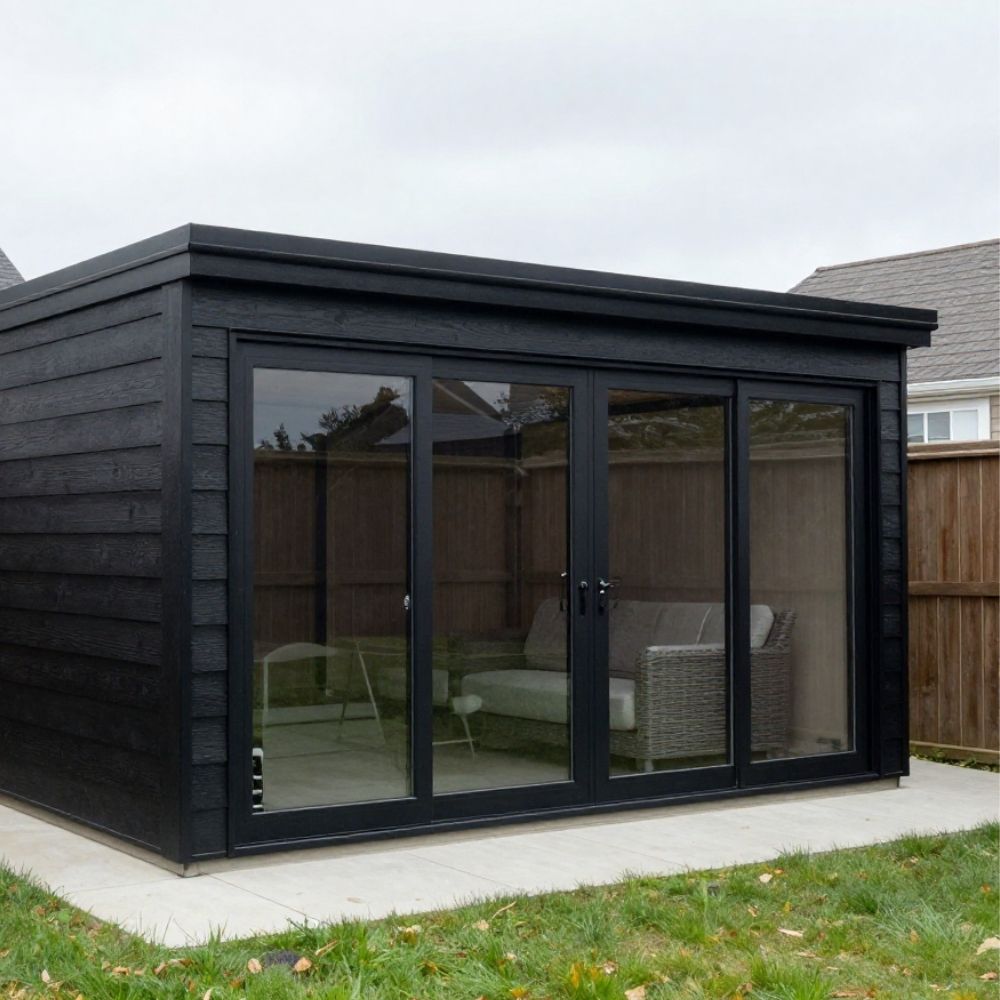
At the top end, a fully insulated garden room becomes a genuine architectural project. These are fully bespoke structures designed to complement your property, often featuring contemporary flat-roof designs with large glazed elevations, green roofs or sedum finishes, premium cladding, and interiors finished to the same standard as any room in the main house.
High-end garden rooms typically include features such as full-height glazing, roof lanterns or skylights, bespoke joinery and integrated storage, high-specification lighting design, smart heating controls, hardwired internet connectivity, and sometimes plumbing for a kitchenette or shower room. External landscaping — decking, pathways, planting, and lighting leading to the garden room — is frequently included as part of the project.
For larger properties in areas like Harbledown, Bridge, and Barham where gardens are generous and the garden room serves as a significant functional space, this level of investment creates something that feels like a genuine addition to the property rather than a garden accessory. A well-designed, high-specification garden room on a property of this calibre adds real value and provides a space you’ll use daily for years to come.
What Affects the Cost?
Several factors influence the final price beyond the basic specification.
Size is the most obvious. A larger garden room requires more materials, more groundwork, and more labour. The relationship isn’t perfectly linear — a room twice the size doesn’t cost exactly double because certain fixed costs like the electrical connection and foundation mobilisation don’t scale proportionally — but size remains the single biggest cost driver.
Ground conditions matter more than most people anticipate. A flat, well-drained garden with firm ground needs minimal preparation. A sloping garden requires levelling or a raised platform. Soft, waterlogged, or clay-heavy ground may need more substantial foundations. Canterbury’s clay soils can present challenges, particularly in gardens that sit heavy with water during autumn and winter. Your builder should assess the ground during the initial visit and account for any additional work in the quote.
Access is another variable. If your garden is accessed through a wide side gate or directly from the rear, materials and equipment reach the site easily. If access is through the house, down a narrow passage, or involves steps and tight turns, materials need carrying by hand, which adds labour time and cost. Many properties in Canterbury’s older streets around the city centre and along the London Road have restricted rear access that needs factoring into the programme and the price.
Cladding choice affects both upfront cost and long-term maintenance. Western red cedar weathers naturally to silver-grey and needs no treatment if you’re happy with that look. Maintaining the original colour requires annual oiling. Thermowood and composite cladding cost more initially but need virtually no maintenance over their lifespan. Each option has its merits, and your builder should explain the trade-offs so you can make an informed choice.
Windows and doors are a significant cost element. Standard double-glazed units are included in most mid-range quotes. Upgrading to aluminium frames, triple glazing, or large-format bi-fold and sliding doors adds £2,000 to £5,000 depending on the size and specification.
Services beyond basic electrics add to the budget. Plumbing for a sink or toilet means running supply and waste pipes from the house, which involves groundwork across the garden. Data cabling, built-in audio, and smart controls are all possible but each carries its own cost.
Do You Need Planning Permission?
Most garden rooms fall within permitted development rights, meaning no planning application is needed. The building must be single storey with a maximum eaves height of 2.5 metres if within two metres of a boundary. Overall height must not exceed three metres with a flat roof or four metres with a dual pitch. It cannot cover more than half your garden and cannot be used as self-contained living accommodation.
Canterbury has several conservation areas, including the city centre, parts of St Dunstan’s, and surrounding villages like Fordwich, Littlebourne, and Chartham. Within these areas, permitted development rights are more restricted. Garden rooms that would be straightforward elsewhere may require a planning application within a conservation area, and your builder should confirm the position before design work progresses.
For the majority of Canterbury properties, a standard garden room proceeds without planning permission. Your builder should check this as one of the first steps in the project.
Getting the Best Value
The best approach is to start with what you need the room for and design the specification around that function. A home office needs good insulation, heating, lighting, and connectivity but doesn’t need a bathroom. A gym needs a strong floor and good ventilation but doesn’t need bi-fold doors. A music room needs acoustic treatment but doesn’t need a kitchenette. Matching the specification to the intended use avoids paying for features you won’t use while ensuring the space performs properly for its purpose.
Get detailed quotes that itemise every element — foundations, frame, insulation, cladding, windows and doors, electrics, heating, internal finishing, and any groundwork or landscaping. A single total figure without breakdown makes comparison between builders impossible and leaves you exposed to additional charges when items you assumed were included turn out not to be.
If you’re considering a garden room at your Canterbury property, get in touch for a free consultation. We’ll visit, discuss what you need the space for, assess your garden and access, and provide a clear, detailed quote so you know exactly what you’re getting and what it costs before you commit.